Renting a car when moving between cities instead of taking the train
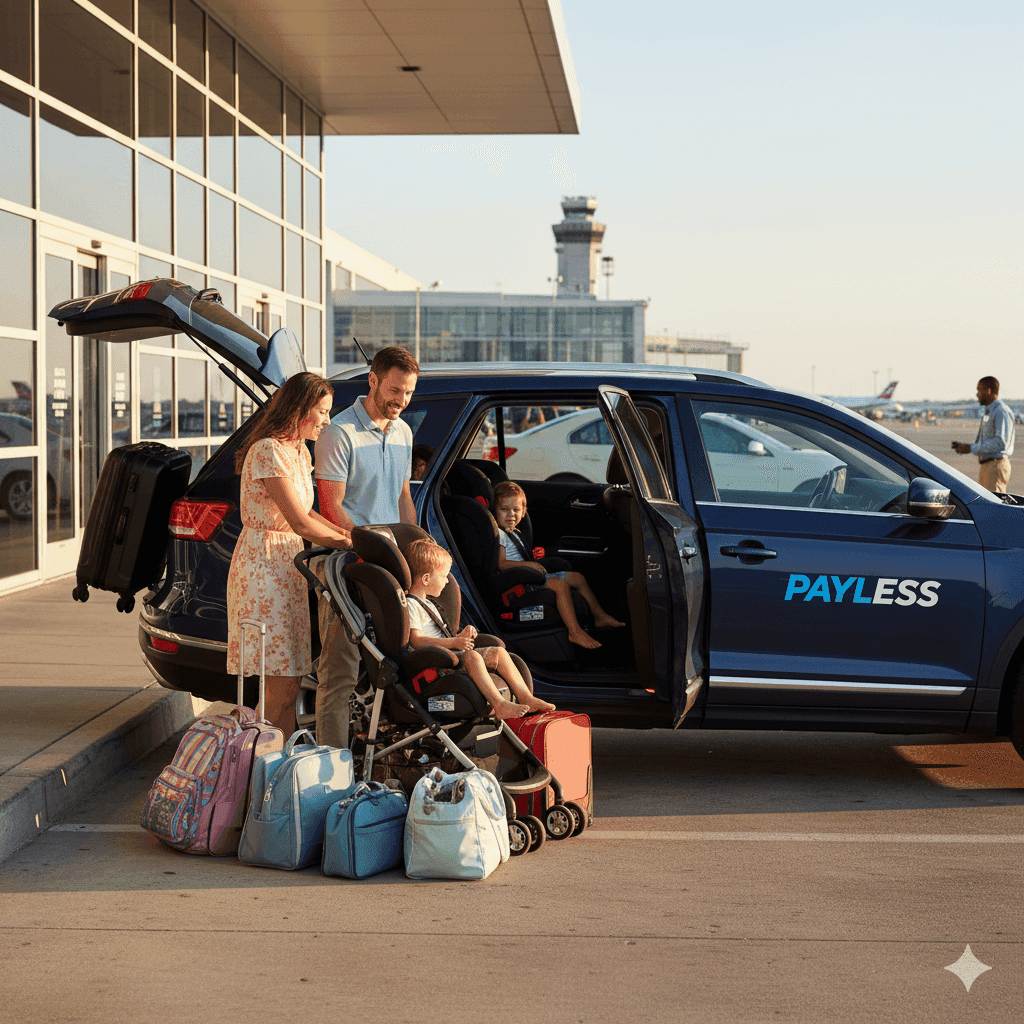
Traveling between cities is no longer just about "what's cheaper". For an individual, door-to-door time, flexibility (stops, schedule changes), comfort, and whether you need to travel outside the city center are often decisive factors. In this article, we will compare car rental vs. train on Slovak (and EU) data, show practical calculations, and add a checklist so you can choose the solution that makes sense for you.
Intercity travel: what it is and why people do it
Intercity travel means moving between two (or more) cities – typically for work, family, errands, to the airport, to an event or for the weekend. The problem is that “travel time” on paper is not the whole story.
In practice, the decision-making process involves:
- availability of connections and the need to transfer,
- the last mile (station ↔ address),
- luggage, work equipment, sports equipment,
- need to stop along the way (meeting, warehouse, client),
- risk of delays or closures,
- total price after factoring in everything (ticket, public transport, taxi, parking, time).
Car rental vs train: quick comparison (for individuals)
| Criterion | Car rental | Train |
| Route flexibility | very high (stops, turns, multiple locations) | low to medium (depending on connections) |
| Door-to-door time | often advantageous outside the center | convenient center-center, if without a transfer |
| Comfort | privacy, own pace | peace, opportunity to work/read |
| Price | advantageous for multiple transfers per day and cost sharing | advantageous for one transfer without follow-up trips |
| Risks | zápchy, parkovanie, zodpovednosť vodiča | delays, closures, occupancy |
| CO₂ per passenger kilometer | higher (especially for 1 person) | usually lower |
Time: it's not the "length of the journey" that matters, but the last mile
When making an intercity transfer, always ask yourself: How many minutes will it actually take me to get from door to door?
Example: Bratislava ↔ Košice (indicative benchmark)
- On the main route Košice - Bratislava, ZSSK communicates express travel times of around 4 h 58 - 4 h 59 min (depending on the direction/timetable adjustments).
- A car can be competitive especially when:
you don't start or end in the city center,
you need to stop "along the way" (e.g. Žilina/Poprad/Prešov),
you are going to an address outside of public transport hubs.
When is the train good for time
- center-center,
- without a transfer,
- if you can use the journey for work (laptop, phone calls),
- if you don't need further transfers in the destination city.
When does car rental win
- multiple stops within one day,
- moving to the outskirts of the city, industrial park, warehouse, client,
- need to be flexible "for a minute" (meeting is postponed, event is extended),
- combination of city + surroundings (e.g. meeting in Žilina + client visit in Bytča + back).
Tip: If you plan 2–3 more trips in the destination city, car rental often tips the equation in favor of flexibility.
Price: how to calculate costs fairly (without self-deception)
Many people only compare the “ticket price” vs. the “rental price”. This is inaccurate. When traveling intercity, compare the total package.
Train cost structure
- ticket (and possible reservation),
- transfer to the station (public transport/taxi/parking at the station),
- transfer from the station to the address (public transport/taxi),
- time reserve (if the connection or connection is late).
Car rental cost structure
- rental price,
- fuel/energy,
- motorway vignette, toll (if relevant),
- parking,
- any fee for stopping/picking up outside the branch or specific handover conditions.
Specific numbers that you can get your hands on
- PAYLESS communicates offers starting from €16 (e.g. Economy category). It also lists benefits that are practical for intercity travel: a highway vignette valid for the Slovak Republic, assistance service and accident + PZP insurance. In the booking form, PAYLESS also has the option "Return at another branch" (conditions and any additional fee vary according to availability).
- When it comes to additional services on the market, it is also a good idea to look at "small" fees. For example, another brand lists as an indication: keybox (return outside opening hours) €20, drop-off/pick-up in BA €25, outside BA according to circuits (e.g. up to 50 km €50, up to 100 km €70, up to 150 km €100, up to 250 km €150).
A simple “break-even” model for an individual
Use this quick calculation (intentionally without unnecessary math):
Total car price = rental + fuel/energy + parking + (possible fees)
Total train price = ticket + transfers to/from the station + (reservations) + possible taxi/public transport
Then add two questions:
- How many additional trips in the destination city would I still have to deal with?
- How much is my time worth if I am “tied” to the timetable?
In practice, renting a car usually breaks in favor of a car if:
- you are going outside the center,
- you make multiple transfers in one day,
- you need to take luggage/technology,
- (or) you can divide the costs between 2–3 people.
Flexibility: the biggest advantage of renting a car for intercity
Intercity travel is not just A → B. It is often A → B → C → back.
Typical situations where a car makes sense
- Business trips: clients in different parts of the city, warehouses and industrial parks.
- Family transfers: pick-up/drop-off, stop along the way, large luggage.
- Events and weekends: transfer to the city + subsequent trips in the surrounding area.
Bonus: “plan B” when changing programs
With a car, you don’t have to worry about whether you missed your connection, whether you have a transfer, or whether the last train is at 21:02. You simply leave when you need to.
Comfort and productivity: the train wins at work, the car at home
It's fair to say: you can often work better on the train - especially if you have a stable connection and peace.
The train is strong if:
- you want to read, write, deal with emails,
- you don't want to drive after a hard day,
- you prefer city center to city center.
The car is strong if:
- you need privacy (phone calls, sensitive topics),
- you carry equipment, samples, luggage,
- you want to take breaks at your own pace.
Reliability and risks: delays vs. congestion
No solution is “risk-free”. When making a decision, it is also helpful to look at what the “normal” delay rate is.
Practical tip: If you are traveling to an important meeting, monitor the current delays on the day of departure (e.g. via public reports). Independent ongoing data from Slovakia often shows that a large part of trains can fit into short delays (of the order of minutes), but it depends on the route, closures and peak times.
Train: what hurts in practice
- delays and closures,
- full connections at peak times,
- timetable changes,
- the last mile (station ↔ destination).
In its communication, ZSSK states the average delay in minutes and ongoing improvements in certain periods – but the reality may vary depending on the route, season and closures.
Car: what hurts in practice
- traffic jams at rush hour,
- parking in the center,
- driver fatigue,
- responsibility for the vehicle (damage, rules).
Practical advice: If you are going to the center of a large city, arrange parking in advance (P+R, hotel parking, garages) - you will save time and nerves.
Sustainability and ESG: numbers worth paying attention to
When considering carbon footprint, always compare per passenger kilometre (pkm).
How are transport modes in the EU doing (indicative benchmarks)
- According to Eurostat, in 2023, cars accounted for approximately 70.6%, planes 14.7%, buses/coaches 7.2% and trains 7.1% of passenger transport performance (in passenger kilometres) in the EU.
- Emission intensity (well-to-wheel) is often given in EU benchmarks as approximately:
passenger car ~143 g CO₂e/pkm,
passenger trains ~33 g CO₂e/pkm,
buses/coaches roughly in between.
How to reduce your impact when choosing a car
- take a passenger (occupancy is key – the average car occupancy in the EU is often quoted as around 1.6 people per car),
- choose a smaller car if you don’t need a big one,
- drive smoothly (city vs. country driving makes a big difference),
- if you can, consider the hybrid/EV segment when renting.
Trend note: According to the EEA (provisional data), average emissions of new passenger cars registered in the EU+NO+IS are set to increase slightly to 106.8 g CO₂/km in 2024 (from 106.4 g in 2023). However, the real footprint also depends on the occupancy and type of driving (city vs. highway, smoothness, downtime).
Trends 2025/2026: why decision-making is becoming even more polarised
1) Demand for rail is growing, but cars still dominate
Eurostat reports that in 2024, 443 billion passenger-kilometres were made by rail in the EU, up 5.8% from 2023 (419 billion) – the highest figure reported by major railway companies since data collection began (2004). However, cars remain the biggest “player” in the modal split.
2) Dynamic pricing and advance planning
- Train: prices and availability are sensitive to peak times and seasons.
- Rental: prices and availability vary according to demand (weekends, holidays, major events).
3) More “combined” journeys
Hybrid work (part of the day online, part of the day in person) creates the need for quick, last-minute transfers. This reinforces the demand for flexibility.
Investment perspective: owning a car vs. leasing (and when does the train make sense)
If you are an individual and think about mobility "as a cost", leasing is often an interesting alternative to owning a car.
Why it is worth looking at TCO (Total Cost of Ownership)
TCO includes not only fuel, but also:
- depreciation (loss of value),
- service, tires, insurance,
- taxes/fees,
- capital tied up.
A specific benchmark from Europe (also useful for Slovakia)
Ayvens (ex LeasePlan) published the Car Cost Index 2025, which models the total costs through a leasing "basket" and lists the average monthly costs of a car across countries. For Slovakia, the average monthly cost is ~908 € / month (modeled at 4 years, 30,000 km / year; various drives included).
How to read it practically:
- If you use the car infrequently (e.g. a few intercity trips per month), renting may make more financial sense.
- If you travel frequently and consistently (every week), the train may work out better – especially if you don't need the car at your destination.
Practical checklist: when to rent a car and when to take the train
Choose a rental car if at least 3 times “yes” is true
- I need more stops in one day.
- I don’t want to deal with transfers from the station and back.
- I have a lot of luggage / work equipment.
- I’m going outside the center (industrial park, warehouse, outskirts).
- I need to be flexible (the program can change).
- I can share the costs (2–3 people).
Choose the train if at least 3 times “yes” is true
- I’m going center-center and without transfers.
- I want to work or relax during the trip.
- Parking at the destination is expensive/difficult.
- I don’t have any additional journeys at the destination.
- I want to minimize my carbon footprint.
Frequently Asked Questions (FAQ)
1) Is renting a car between cities cheaper than the train?
It can be – especially if you have additional transfers at your destination or you share the costs. If it is “just” one transfer from city center to city center, the train is often cheaper.
2) Is it worth renting a car for one day?
Yes, if you have several meetings or need flexibility. PAYLESS communicates prices from €16/day, which makes one-day transfers realistic.
3) What makes renting a car more expensive than intercity?
Most often fuel/energy, parking and specific fees (e.g. drop-off/pick-up outside the branch or special conditions for handover). Therefore, always calculate the “whole package”.
4) When is the train clearly better?
If you are going city center to city center, without transfers, and you do not need to transfer further at your destination. Plus if you want to use the trip for work.
5) Is a car more environmentally friendly if I go alone?
On average, no. For one person, a car has a significantly higher footprint per passenger kilometer than a train. However, if you take a passenger, the difference decreases.
Summary / TL;DR
- When traveling intercity, compare time and price door-to-door, not just ticket vs. rental.
- Car rental wins out when there are multiple stops, outside the city center, and when you need flexibility.
- Train is the best for city center-city, no transfers, and if you want to work while you're on the road.
- In the EU, cars still have the largest share of passenger transport, but trains are generally more emission-efficient per pkm.
- If you don't use your car often, renting can also make sense financially (ownership has a high TCO).
Keywords and entities (used in the text)
Main KW: intercity travel, flexibility
Related KW: intercity travel, car rental, car rental, train travel, car rental vs train comparison, door-to-door time, last mile, travel costs, TCO, carbon footprint, passenger-kilometer, CO2e/pkm, highway vignette, parking, vehicle parking
Entities: PAYLESS Car Rental, Slovakia, ZSSK, Eurostat, European Environment Agency (EEA), Ayvens (LeasePlan), Kriváň express (ZSSK)
Conclusion
If you only travel between cities occasionally, renting a car is often the easiest way to gain flexibility without paying the fixed costs of owning your own car. If you travel frequently and center-center, the train may be more efficient.
Want to compare it on your specific route (A→B→C, time, price, parking)? Choose a segment and date and book your vehicle through PAYLESS – or have a suitable alternative recommended based on the number of stops and luggage.
Sources and methodologies (selection)
- Eurostat: modal split of passenger transport in the EU (shares by passenger-kilometres) and rail transport statistics (e.g. 2024: 443 billion pkm).
- European Environment Agency (EEA): comparison of GHG intensity of different transport modes (gCO₂e per passenger-kilometre) and emissions of new car registrations (provisional data 2024).
- European Parliament (infographics/data): indicative data on passenger car occupancy (≈ 1.6 persons) and the context of road transport emissions.
- Ayvens Car Cost Index 2025: benchmark of monthly costs/TCO across European countries.
- PAYLESS Car Rental Slovakia: information on offer and indicative prices.
